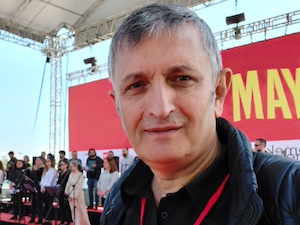
The 16th Jubilee Congress of the Georgian Trade Union Confederation (GTUC) celebrating 120 years of trade union history in Georgia, was held on October 24, 2025. 175 delegates and more than 50 invited local and international guests, including those from trade unions from various countries, participated in the congress.
The congress featured a presentation of the new anthem of the Georgian Trade Union Confederation and a film depicting the history of the Georgian trade union movement.
International and local guests and representatives of trade unions of various countries greeted the congress.
The congress heard and adopted the 2021-2025 report of the Georgian Trade Union Confederation, which included the GTUC activities in the areas of workers’ protection, legislative and analytical work, awareness-raising, international activities and labour safety. The congress focused on the importance of the country’s European integration in ensuring decent labour standards for workers. According to the report:
 During the reporting period, the GTUC was involved in and prepared more than 10 legislative initiatives, which concerned issues such as: a package of amendments to the Organic Law of Georgia “Labour Code of Georgia”, including in the direction of ensuring women’s rights and gender equality, minimum wage, unemployment benefits and unemployment insurance, labour migration, labour safety, etc;
During this period, the Legal Department provided consultations to more than 45,100 people. 97% of labour disputes were resolved in favour of workers, as a result of which they received various types of compensation, the total amount of which during the reporting period amounted to 4,200,225 GEL;
As a result of collective negotiations, collective agreements and mediation, workers received economic benefits, the total amount of which exceeds 440 million GEL;
514 information meetings (trainings, seminars) were held, in which 11,822 people (workers, civil servants, employers, students, journalists, lawyers, etc.) participated. The topics of the meetings were: labour rights, labour safety, social protection, women’s rights and gender equality, civil servants’ rights, labour standards in the European integration process, etc;
38 trainers were trained, who are actively participating in awareness-raising and organizing areas;
Were prepared: 16 information brochures/bulletins, 35 videos, 230 information cards, 44 open offices, which reached more than 12,000 people;
The GTUC hosted as well as participated in 212 international events, with involvement of 1,329 representatives of the GTUC and its sectoral organizations.
The Congress heard the report of the Control and Revision Commission of the Georgian Trade Union Confederation (GTUC) on the work done. It also adopted a number of resolutions, including a special resolution on the special status of the trade unions of the autonomous republics of Adjara and Abkhazia in the structure of the Georgian Trade Union Confederation and on the formation of a unified, consolidated and mutual-solidarity trade union movement.
The Congress, for the first time in the history of the Georgian trade union movement, held elections with a new structure, where the GTUC will be led by a General Secretary and a President instead of a Chairman. Irakli Petriashvili was elected General Secretary of the GTUC by secret ballot, and Raisa Liparteliani was elected President. The positions of Deputy General Secretaries were held by Tamar Surmava and Lavrenti Alania.
The Georgian Trade Unions Confederation adopted an action programme for 2026-2029, according to which, over the next 4 years, the GTUC will work on issues such as:
 Minimum wage;
Amendments to labour legislation to ensure compliance with ILO and EU standards;
Progressive taxation;
Subsistence allowance;
Reduction of income inequality;
Poverty alleviation;
Formalization of informal employment;
Labour migration;
Protection of women’s labour rights and encouragement of their economic activity;
Climate change and just transition;
Pensions;
Protection of the interests of youth and other vulnerable groups;
Improvement of active labour market policy mechanisms;
Improving rights and social situation of those employed in the care economy and digital labour platforms;
Improving vocational education system;
Ratifying a number of ILO conventions related to women’s rights and labour safety, etc.
At the end of the congress, 30 trade union members employed in various fields were awarded for their outstanding contribution to trade union activities.
It should be noted that the Congress was preceded by a conference on October 23 titled “120-Year History of Georgian Trade Unions, Modern Challenges and Ways to Solve Them”, where participants were provided with information about the history of the Georgian trade union movement and were also given the opportunity to discuss modern challenges in the field of labour.



 Labour News Network